Three situations. One record.
Three situations. One record.
Lumiare is used to deliver a project, to prepare one, and to prepare for an audit. Pick the one you are in.
We are delivering a project
IT Project Delivery
We are preparing a project
PMO: Project Preparation and Governance
We are preparing for an audit
Compliance and Audit
IT Project Delivery
Lumiare turns workshops, calls and documents from a client into one verified requirements register, and writes the proposal, statement of work and requirements specification from it.

The situation
A project starts with weeks of discovery. Several client teams, several workshops, calls that get recorded and calls that do not, documents in three formats. The requirements that come out of it live in someone’s notes until they are written up, and the proposal, the statement of work and the build each start from a slightly different version of them.
What changes with Lumiare
All of it feeds one project under the client’s company. Each requirement is one item with an owner, a completeness score, a version history and a source. Disagreements between what two stakeholders said are raised on upload and settled before they reach a document. The proposal and the statement of work are written from the verified register, and the delivery team inherits the same project.
The loop, in delivery terms
Capture
Workshops, calls and documents in
Structure
One item per requirement
Verify
Owners verify; contradictions resolved
Generate
Proposal, statement of work, requirements specification
Documents this use case produces
Proposal · Statement of work · Requirements specification · Scope description · Project charter · Project summary
Who this is for
Implementation partners and system integrators, and consultancies running multi-stakeholder discovery. Owned by the head of delivery or the partner, run by the engagement manager or architect, used daily by analysts and consultants with client stakeholders as co-authors.
Honest fit
If your projects are short and run by one person, the register will feel heavier than the work. Lumiare pays off when several people from more than one organization produce the requirements and someone has to defend them later.
A day with Lumiare
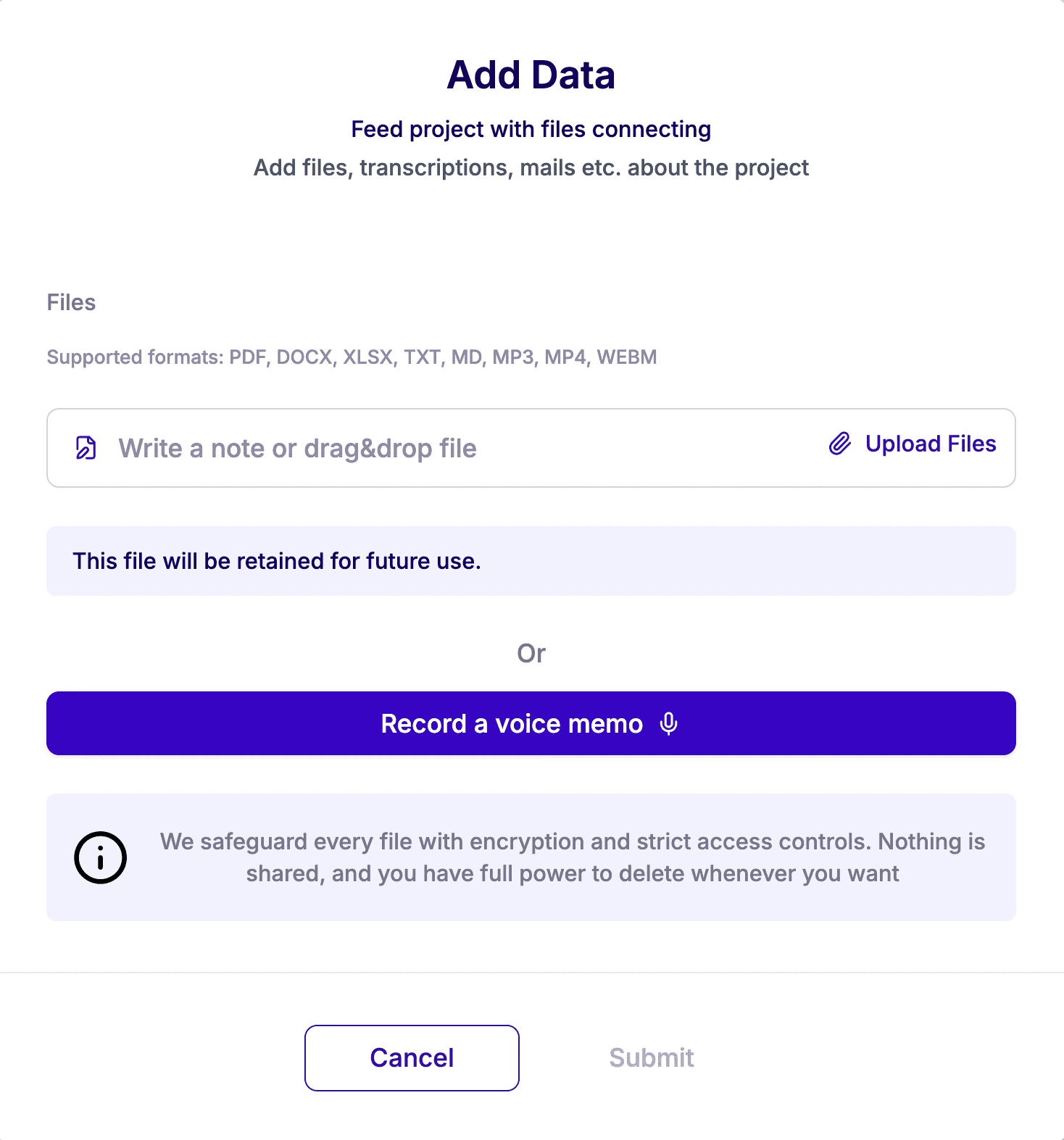
“I ran a discovery call this morning and I want the requirements captured before lunch.”
By lunch the requirements from the call are items in the project, each with a score and an owner to confirm it. The recording went in as a file; the file list shows it filled 28 of the 28 items it touched. What is still red is the agenda for the next call.

A day with Lumiare
“The client said something today that does not match what their IT lead told us last week.”
The mismatch is caught the same afternoon, with both statements and their sources side by side. The consultant names the two people as owner and reviewer, they settle it in the thread, and one version is verified with the decision on record. Nothing reaches the proposal unresolved.


A day with Lumiare
“I want to send a statement of work the delivery team will not reopen.”
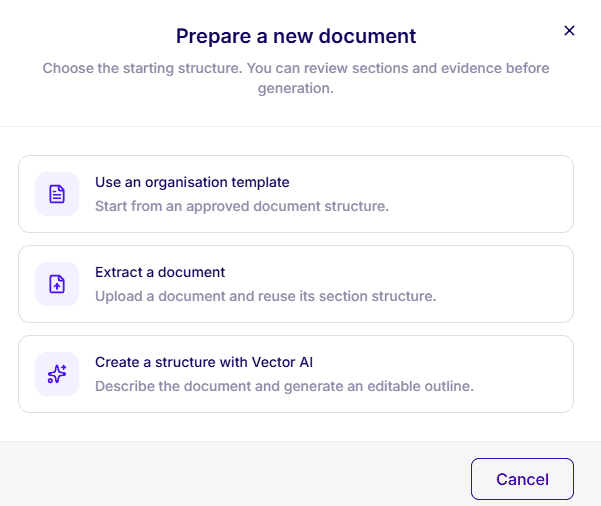
The statement of work is generated from the firm’s own template, every section linked to verified items, and any section without evidence is flagged before a word is written. The team edits it together and exports it. At signature, delivery opens the same project and reads the history. There is no handover meeting.
Our client's stakeholders are not Lumiare users. Can they take part?
What happens at handover to the delivery team?
Is Lumiare a meeting recorder or a transcription tool?
What do I need to start?
We are delivering a project
IT Project Delivery
We are preparing a project
PMO: Project Preparation and Governance
We are preparing for an audit
Compliance and Audit
IT Project Delivery
Lumiare turns workshops, calls and documents from a client into one verified requirements register, and writes the proposal, statement of work and requirements specification from it.
The situation
A project starts with weeks of discovery. Several client teams, several workshops, calls that get recorded and calls that do not, documents in three formats. The requirements that come out of it live in someone’s notes until they are written up, and the proposal, the statement of work and the build each start from a slightly different version of them.
What changes with Lumiare
All of it feeds one project under the client’s company. Each requirement is one item with an owner, a completeness score, a version history and a source. Disagreements between what two stakeholders said are raised on upload and settled before they reach a document. The proposal and the statement of work are written from the verified register, and the delivery team inherits the same project.
The loop, in delivery terms
Capture
Workshops, calls and documents in
Structure
One item per requirement
Verify
Owners verify; contradictions resolved
Generate
Proposal, statement of work, requirements specification
Documents this use case produces
Proposal · Statement of work · Requirements specification · Scope description · Project charter · Project summary
Who this is for
Implementation partners and system integrators, and consultancies running multi-stakeholder discovery. Owned by the head of delivery or the partner, run by the engagement manager or architect, used daily by analysts and consultants with client stakeholders as co-authors.
Honest fit
If your projects are short and run by one person, the register will feel heavier than the work. Lumiare pays off when several people from more than one organization produce the requirements and someone has to defend them later.
A day with Lumiare
“I ran a discovery call this morning and I want the requirements captured before lunch.”
By lunch the requirements from the call are items in the project, each with a score and an owner to confirm it. The recording went in as a file; the file list shows it filled 28 of the 28 items it touched. What is still red is the agenda for the next call.
A day with Lumiare
“The client said something today that does not match what their IT lead told us last week.”
The mismatch is caught the same afternoon, with both statements and their sources side by side. The consultant names the two people as owner and reviewer, they settle it in the thread, and one version is verified with the decision on record. Nothing reaches the proposal unresolved.
A day with Lumiare
“I want to send a statement of work the delivery team will not reopen.”
The statement of work is generated from the firm’s own template, every section linked to verified items, and any section without evidence is flagged before a word is written. The team edits it together and exports it. At signature, delivery opens the same project and reads the history. There is no handover meeting.
Our client's stakeholders are not Lumiare users. Can they take part?
What happens at handover to the delivery team?
Is Lumiare a meeting recorder or a transcription tool?
What do I need to start?
We are delivering a project
IT Project Delivery
We are preparing a project
PMO: Project Preparation and Governance
We are preparing for an audit
Compliance and Audit
IT Project Delivery
Lumiare turns workshops, calls and documents from a client into one verified requirements register, and writes the proposal, statement of work and requirements specification from it.
The situation
A project starts with weeks of discovery. Several client teams, several workshops, calls that get recorded and calls that do not, documents in three formats. The requirements that come out of it live in someone’s notes until they are written up, and the proposal, the statement of work and the build each start from a slightly different version of them.
What changes with Lumiare
All of it feeds one project under the client’s company. Each requirement is one item with an owner, a completeness score, a version history and a source. Disagreements between what two stakeholders said are raised on upload and settled before they reach a document. The proposal and the statement of work are written from the verified register, and the delivery team inherits the same project.
The loop, in delivery terms
Capture
Workshops, calls and documents in
Structure
One item per requirement
Verify
Owners verify; contradictions resolved
Generate
Proposal, statement of work, requirements specification
Documents this use case produces
Proposal · Statement of work · Requirements specification · Scope description · Project charter · Project summary
Who this is for
Implementation partners and system integrators, and consultancies running multi-stakeholder discovery. Owned by the head of delivery or the partner, run by the engagement manager or architect, used daily by analysts and consultants with client stakeholders as co-authors.
Honest fit
If your projects are short and run by one person, the register will feel heavier than the work. Lumiare pays off when several people from more than one organization produce the requirements and someone has to defend them later.
A day with Lumiare
“I ran a discovery call this morning and I want the requirements captured before lunch.”
By lunch the requirements from the call are items in the project, each with a score and an owner to confirm it. The recording went in as a file; the file list shows it filled 28 of the 28 items it touched. What is still red is the agenda for the next call.
A day with Lumiare
“I ran a discovery call this morning and I want the requirements captured before lunch.”
By lunch the requirements from the call are items in the project, each with a score and an owner to confirm it. The recording went in as a file; the file list shows it filled 28 of the 28 items it touched. What is still red is the agenda for the next call.
A day with Lumiare
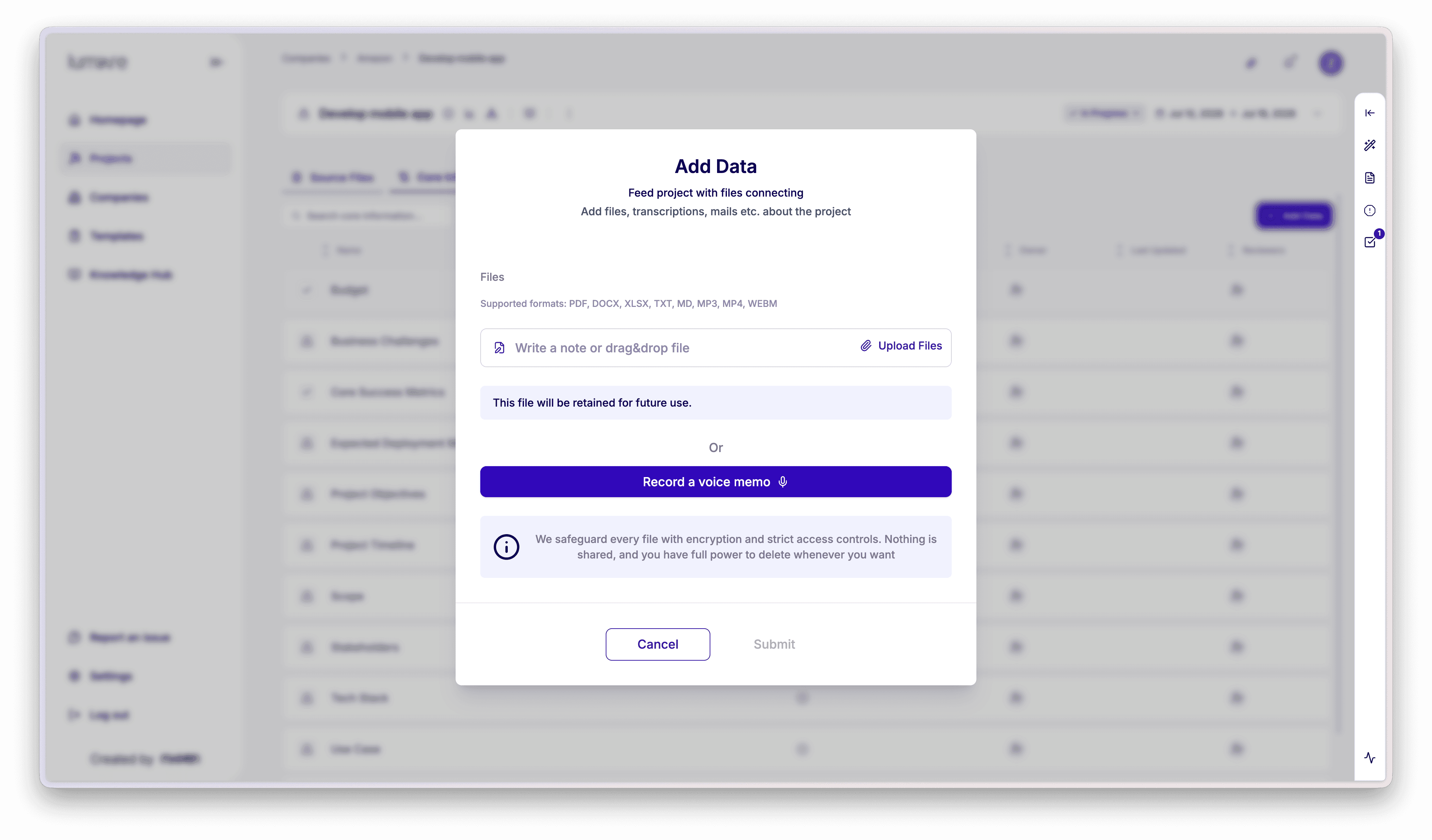
“I ran a discovery call this morning and I want the requirements captured before lunch.”
By lunch the requirements from the call are items in the project, each with a score and an owner to confirm it. The recording went in as a file; the file list shows it filled 28 of the 28 items it touched. What is still red is the agenda for the next call.
Our client's stakeholders are not Lumiare users. Can they take part?
What happens at handover to the delivery team?
Is Lumiare a meeting recorder or a transcription tool?
What do I need to start?
